
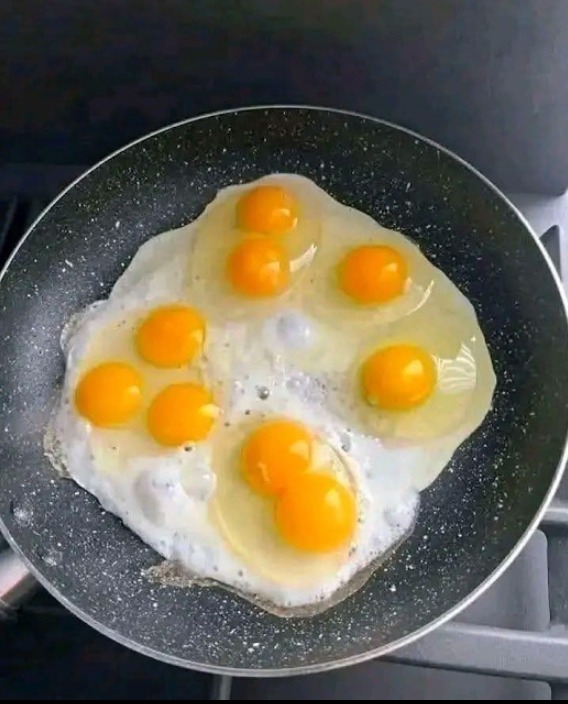
At first glance, it’s a simple scene: golden yolks glistening in a hot pan, simmering at the edges. But upon closer inspection, you discover much more than just a simple breakfast. This inviting image—several eggs frying side by side—is a window into the world of science, tradition, and good health.
Eggs are among the world’s most versatile foods: simple, uncomplicated, and endless. Yet mastering them—the first, seemingly simple egg—remains a challenge for chefs around the world. Let’s explore what makes eggs extraordinary, from their biology to their culinary qualities.
1. The global passion for eggs:
Eggs transcend borders. From French omelets to Chinese tea eggs, from Mexican huevos rancheros to Middle Eastern shakshuka, they are an expression of culture and creativity.
The image of several eggs boiling together—with their yolks glossy and runny—is more than just a pleasure; it symbolizes abundance. These intense yellow-orange hearts aren’t just beautiful: they symbolize the freshness and richness of the ingredients they contain. While we often consume one or two eggs at a time, having several at once presents its own challenges, beyond the precision required: preserving the yolk intact, finding effective alternative uses, and achieving a perfect result.
In many cultures, eggs symbolize rebirth, fertility, and new beginnings – an apt metaphor for their role in both sustaining life and celebrating it.
2. Beyond the Egg: A World of Possibilities.
While chicken eggs dominate our kitchens, eggs from other birds offer unique flavors and textures:
Duck eggs: larger, richer, with a creamier yolk, ideal for baking.
Quail eggs: delicate and speckled, ideal for decorating or preserving.
Ostrich eggs: a curiosity (one egg is equivalent to 24 chicken eggs!), but rarely found outside of specialty shops.
Double-yolked eggs also exist, a rarity occurring about one in 1,000 eggs. Often laid by young hens, these double-yolked eggs are prized for their exceptional abundance and symbolic value. In your dishes, they are not just a curiosity, but a true asset.
Nutritionally, eggs are a veritable treasure trove of nutrients: high-quality protein, vitamins D and B12, selenium, and choline (essential for brain health). Eggs with two yolks contain slightly more nutrients—and, admittedly, higher cholesterol—but recent research confirms that moderate egg consumption does not increase the risk of cardiovascular disease for most people.
3. Learning in a shell
To cook eggs properly, you need to know what they contain:
Shell: A protective, porous barrier.
Egg white: Composed of 90% water and proteins, which coagulates and becomes opaque when exposed to heat.
Yolk: A nutrient-rich sphere composed of lipids, proteins, and emulsifiers, held together by a delicate membrane.
Heat denatures the egg white: it unfolds and melts, forming solid structures. This is why soft-boiled eggs become firm. However, overheating causes the egg white to shrink excessively, resulting in moisture loss and a rubbery texture.
The yolk membrane is surprisingly tough, but you have to be careful not to puncture it, cook it too quickly, or turn it abruptly, or it will break. Patience is key.
4. Mastering egg cooking: technique and timing.
Definition of different cooking styles.
Fried eggs: cooked on one side only; the yolk remains runny.
Soft-boiled eggs: turned briefly; the yolk is runny but closed.
Hard-boiled eggs: the yolk is cooked to perfection, according to your preference.
Tips for cooking multiple eggs:
use a large, heavy-bottomed pan to distribute heat evenly.
Crack the eggs gently on a flat surface (not on the edge of the pan) to avoid chipping the shells and breaking the yolks.
Fry over low or medium heat; high heat will burn the whites before the yolk is cooked.
Choose your pan wisely: nonstick for ease, well-seasoned cast iron for more flavor and crispy edges.
Fats: butter or oil?
Butter adds a rich flavor and promotes browning, but burns easily.
Oil (like canola or avocado oil) has a higher smoke point.
Tip: Combine the two; pour the oil over the butter first to protect it, then pour the butter on top to flavor it.
5. Eggs and Health: Debunking the Myths
Eggs, once criticized for their cholesterol content, are now recognized as a complete protein source, containing all nine essential amino acids. They are also rich in:
Choline (improves memory and liver function),
lutein and zeaxanthin (protect the eyes),
vitamin D (rarely found in foods, essential for the immune system):
For most healthy people, eating 1-2 eggs a day is not only safe but also beneficial.
6. Original ideas for using multiple eggs.
Do you like cracking several at once? Try these ideas:
A fluffy omelet with aromatic herbs, cheese, and roasted vegetables.
Shakshuka: eggs poached in a spicy tomato sauce.
Breakfast casserole: a bread, egg, and sausage casserole.
Crème brûlée: a creamy pudding made with leftover egg yolks.
7. Did you know…
The largest chicken egg ever recorded weighed over 340g (with five yolks!).
An ostrich egg takes 45 minutes to boil hard.
At Easter, eggs are traditionally associated with spring and renewal, a custom that dates back thousands of years.
8. Tips to avoid common mistakes:
Sticky eggs? → Use enough fat and heat the pan well.
Broken yolks? → Handle the eggs gently and crack them on a flat surface.
Rubbery texture? → Lower the heat and don’t overcook them.
A shell in the pan? → First crack the eggs into a small bowl, then slide them into the pan.
An egg is never just an egg. It’s a miracle of nature, a concentrated source of nutrients, and a blank canvas for culinary expression. Whether it’s a single egg or a dozen donuts, every crack of the shell is an invitation: to nourish, to create, to connect with the food that has sustained humanity for centuries.
So, next time you see a pan full of sizzling egg yolks, don’t just count them. Enjoy them. Because it’s in that simple moment that the quiet magic of cooking lies.